What did you learn about aspartame?
Consumers said aspartame can help with lowering calories, is safer that what people say, and that it tastes like sugar, giving sweetness with no calories.


Aspartame is a low-calorie sweetener used in a variety of low- and reduced-calorie foods and beverages around the world, including carbonated soft drinks, powdered soft drinks, chewing gum, confections, gelatins, dessert mixes, puddings and fillings, frozen desserts, yogurts, tabletop sweeteners, and some medicines such as vitamins and sugar-free cough drops. As it is 200 times sweeter than sugar, only tiny amounts of aspartame are needed to achieve the desired sweetness, reducing the number of calories compared with sugar.
Amino acids are the building blocks of all proteins in food as well as protein tissues in the body. Aspartame is composed of two amino acids, aspartic acid and phenylalanine, and a small amount of methanol. These same compounds are also found in much larger amounts in frequently eaten foods like meat, milk, fruits, and vegetables. The amount you consume from aspartame is miniscule compared with other foods and beverages and the body uses the amino acids and methanol in exactly the same way. It is unable to distinguish the original source and metabolizes the compounds the same regardless of the source they come from.
Regulatory agencies in more than 100 countries have all affirmed aspartame’s safety. The scientific evidence overwhelmingly supports the safety of aspartame even in amounts far greater than people typically consume.
With more than 200 studies attesting to its safety, aspartame is one of the most researched food additives in the world and has a long history of safe use. A thorough review of the research by The European Food Safety Authority released in 2013 concluded that aspartame is safe for the general population including infants, children and pregnant women. Scientists from the U.S. Food & Drug Administration (FDA) have also reviewed the scientific data regarding the safety of aspartame in food and concluded that it is safe for the general population. According to the U.S. Department of Agriculture, aspartame is one of the most exhaustively studied substances in the human food supply.
Since aspartame contains phenylalanine, aspartame is not recommended for individuals with phenylketonuria (PKU), a rare hereditary disease, who have difficulty in metabolizing phenylalanine.
In 2012 Academy of Nutrition and Dietetics (AND) stated, “Consumers can safely enjoy a range of nutritive sweeteners and nonnutritive sweeteners (NNS) when consumed within an eating plan that is guided by current federal nutrition recommendations, such as the Dietary Guidelines for Americans and the Dietary Reference Intakes, as well as individual health goals and personal preference.” In reference to any adverse effects aspartame related to aspartame consumption, AND concluded, “Aspartame consumption is not associated with adverse effects in the general population.”
Yes. Since aspartame offers the same sweet taste as sugar without the calories it is a very effective tool to help meet dietary recommendations. The U.S. Dietary Guidelines for Americans 2015 – 2020 advises consuming less than 10 percent of daily calories from added sugars. The World Health Organization’s 2015 Sugars intake for adults and children also recommends reducing the intake of free sugars to less than 10% of total energy intake in both adults and children. . Simply substituting a can of diet soft drink for a regular soft drink saves about 150 calories; substituting a packet of low-calorie tabletop sweetener for two teaspoons of sugar three times daily (e.g., in coffee and tea and on cereal) saves about 100 calories a day; and 4-oz. of aspartame-sweetened pudding substituted for regular pudding saves 80 calories.
Yes. Research documents the safety of aspartame during pregnancy and breastfeeding. Additionally, regulatory agencies consider both the mother and the offspring when they review the scientific evidence and consider the safety of food ingredients, including aspartame. Aspartame is broken down in the body to the same components (phenylalanine, aspartic acid and methanol) eaten daily in common diets by pregnant and breast feeding women. Sufficient calories are important during pregnancy, and calories should come from foods that contribute to nutrient needs rather than from foods low in nutrients. The variety of foods and beverages sweetened with aspartame can help satisfy a pregnant woman’s taste for “sweets” without adding extra calories, leaving room for more nutritious foods.
Yes. Aspartame can be used in a wide variety of recipes. However, in some recipes requiring lengthy heating or baking, a loss of sweetness may occur. The product may not be as sweet as desired. Therefore, it is best to use aspartame in recipes from the manufacturers of the products as they have been specially developed to retain sweetness. Adding aspartame to some recipes at the end of heating will also help maintain sweetness.
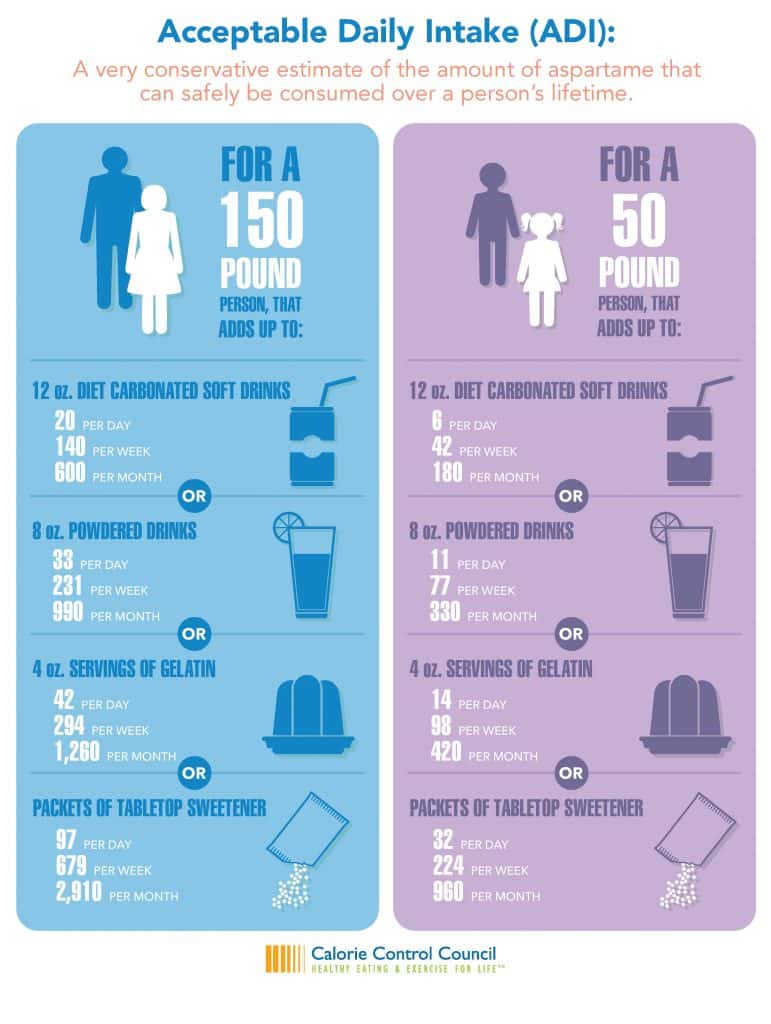
The ADI is a very conservative estimate of the amount of a substance that can safely be consumed on a daily basis over a person’s lifetime. The U.S. FDA has set the ADI for aspartame at 50 mg/kg of body weight/day. This means a 150-pound adult would have to consume about 20 12-oz. diet carbonated soft drinks, or 33 8-oz. servings of powdered soft drink, or 42 4-oz. servings of gelatin, or 97 packets of tabletop sweetener, each day to reach the ADI. A 50-pound child would have to consume about 6 12-oz. cans of carbonated beverage, or 11 8-oz. servings of powdered soft drink, or 14 4-oz. servings of gelatin, or 32 packets of tabletop sweetener, each day to reach the ADI. Intake past the ADI is still safe as well. The ADI is a conservative estimated safe exposure level, which anticipates continuous lifetime exposure. It should not be regarded as a specific point at which safety ends and possible health concerns begin.
Very little aspartame is used in food. It only takes 1/200 of a teaspoon of aspartame to get the same sweetness as a teaspoon of sugar. People often think they are consuming more aspartame than they are because of the amount in the sweetener packet but aspartame is combined with other ingredients in the packet so it is more convenient to add to foods and beverages. You could never even see the speck of aspartame if it was pure!
No. The scientific evidence clearly demonstrates that aspartame is safe and not associated with adverse side effects, even in amounts much greater than people typically consume. The U.S. Food and Drug Administration (FDA) has investigated alleged complaints since 1982 and stated that there is no “reasonable evidence of possible public health harm” and “no consistent or unique patterns of symptoms reported with respect to aspartame that can be causally linked to its use.”
In 1984, the Centers for Disease Control and Prevention (CDC) reviewed 517 consumer complaints related to their use of aspartame and concluded that the complaints “do not provide evidence of the existence of serious, widespread, adverse health consequences attendant to the use of aspartame.” The CDC further noted, “The majority of frequently reported symptoms were mild and are symptoms that are common in the general populace.” In response to these complaints, numerous additional scientific studies were done by prominent researchers at major academic institutions; the results of these studies overwhelmingly demonstrate that aspartame is not associated with adverse health effects, including headaches, seizures, changes in mood, cognition or behavior, or allergic reactions.
No. Overwhelming scientific evidence shows that aspartame does not increase hunger, appetite, food intake, or weight. Studies have actually found that aspartame can be an effective tool for weight management. The Academy of Nutrition and Dietetics states, “Use of aspartame and aspartame-sweetened products as part of a comprehensive weight loss or maintenance program by individuals may be associated with greater weight loss and may assist individuals with weight maintenance over time.”
No. A 2015 study found no difference in symptoms between participants who consumed aspartame and those who did not, and no consequential differences between aspartame sensitive and non-sensitive individuals
Although a few people have claimed that they have experienced allergic-type symptoms related to consuming aspartame, these are anecdotal reports. Nevertheless, carefully controlled scientific studies were conducted at the National Institutes of Health and at six major academic medical centers. The results of these studies with people who believed aspartame caused their allergic reactions clearly demonstrated that aspartame is not associated with allergic reactions. Those who suspect a food allergy should seek diagnosis and treatment from a qualified medical professional, such as a board-certified allergist. Self-diagnosis can delay treatment of a more serious medical problem.
No. The scientific literature does not support this. Researchers have consistently found no difference in headache incidence among those consuming aspartame vs. those who do not. These include studies in the New England Journal of Medicine, The Journal of Clinical Pharmacology, and The Journal of Allergy and Clinical Immunology.
Aspartame is safe and useful for people with diabetes. Research has shown that aspartame does not affect short-term or long-term blood sugar levels. According to the Joslin Diabetes Center, “The safety of aspartame has been well established. The results of these scientific studies have shown that eating products sweetened with aspartame is no different from eating other foods and is not associated with adverse health effects.”
Phenylketonuria (PKU), a rare inherited disease that prevents the essential amino acid phenylalanine from being properly metabolized. An essential amino acid is required for normal growth, development, and body functioning and must be obtained from the diet, as the body cannot make it. Because those with PKU cannot metabolize phenylalanine from any dietary source so it can accumulate in the body and cause health problems including mental retardation. In the U.S. and many other countries, routine screening for PKU is required for all newborns. This routine testing helps to identify individuals with this disorder early. People with PKU are placed on a special diet with a severe restriction of phenylalanine from birth to adolescence or after. Women with PKU must remain on the special diet throughout pregnancy. Since individuals with PKU must consider aspartame as an additional source of phenylalanine, the US requires that aspartame-containing foods must state “Phenylketonurics: Contains Phenylalanine” to help individuals identify sources of this amino acid. In the U.S., about 1 in 15,000 babies is born with PKU.
One study of epileptic children found there was no difference in the occurrence of seizures when they consumed a diet containing aspartame versus one that did not. In another study, adults and children given capsules with aspartame or a placebo experienced no seizures or other adverse effects from consuming aspartame. While claims have been made that aspartame can cause seizures in people with epilepsy, research has shown it does not.
No. Studies conducted at academic institutions, including Yale University Medical School and Vanderbilt University Medical School, found that aspartame consumption does not cause behavioral changes in children, including those diagnosed with “hyperactivity” or attention deficit disorder (ADD). The studies evaluated behavior in children given large amounts of aspartame.
Methanol poisoning occurs when people consume non-food products that contain very high levels of methanol, like windshield washer fluid, some antifreeze and de-icers, paint remover, or industrial alcohol. In some cases, home-distilled spirits can also contain large amounts of methanol. Drinking these products can overwhelm the body’s ability to use up methanol, and then it can cause problems. Because foods that naturally contain methanol and foods and beverages with aspartame have very low levels, it is impossible to eat or drink enough to produce methanol poisoning.
First off, it’s important to know that the body naturally produces formaldehyde during metabolism. While formaldehyde is a scary word, it is also found naturally in coffee, cheese and many other foods. In contrast, aspartame does not actually contain any formaldehyde. When the body metabolizes methanol, it is converted into formaldehyde whether it comes from apples, tomato juice or aspartame. The body uses formaldehyde very quickly or converts it to formic acid that is excreted in the urine or broken down to carbon dioxide and water. Formaldehyde does not build up in the body. What it doesn’t need, the body gets expels. There is no risk from formaldehyde that is from the methanol derived from aspartame or fruits and vegetables.
Aspartame is digested in the small intestine. During digestion it is broken down by the same digestive enzymes as other protein foods into two amino acids, aspartic acid and phenylalanine, also found in foods such as milk and eggs. Aspartame never enters the bloodstream intact. The body uses the amino acids to make new tissues and cells, just like it does with amino acids from the digestion of other protein foods. A small amount of methanol also results from aspartame breakdown. Fruits and vegetables also contain methanol. In fact, a tomato juice contains about six times as much methanol the same amount of an aspartame-sweetened beverage.
Extensive market research has shown that aspartame consumption patterns for the general population and various subgroups are well below the Acceptable Daily Intake (ADI). Aspartame consumption by high-level consumers (90th percentile) in the general population, including children, is between 5% and 10% of the ADI. This means that 9 out of 10 people consume less than 10% of the ADI. Children consume proportionately larger amounts of all food ingredients than do adults in relation to their body weight. The 90th percentile aspartame consumption by children between the ages of two and five is only about 10% of the ADI. Children need calories to achieve proper growth and development, and parents should supervise their children’s diet to avoid dietary excesses or nutritional deficiencies.
Consumers said aspartame can help with lowering calories, is safer that what people say, and that it tastes like sugar, giving sweetness with no calories.
180 to 200 times sweeter than sucrose.
Aspartame has been extensively studied in animals and humans for more than two decades. FDA has affirmed the safety of aspartame 26 times over a period of 23 years. For more information about the safety of aspartame, click here.
Aspartame is classified as a “general purpose sweetener” by FDA and is approved for use in all foods and beverages. Aspartame is approved for use in over 200 countries.
It is approved for use in any category of food or beverage, including tabletop sweeteners, carbonated soft drinks, refrigerated and nonrefrigerated ready-to-drink beverages, frozen desserts and novelties, puddings and fillings, yogurt-type products, baked goods and candies.

Aspartame has a very interesting history with lots of twists and turns since its approval more than 30 years ago.
Learn more
Learning to live a healthier lifestyle is easy when you change one small thing at a time. Find recipes and tips to start the change today!
Learn more
Substituting aspartame for sugar or other calorie-containing sweeteners allows people to indulge sweet cravings while consuming fewer calories.
Learn more