

The scientific evidence overwhelmingly supports the safety of aspartame even in amounts far greater than people typically consume. With over 200 studies attesting to its safety, aspartame is one of the most researched food ingredients/additives in the world and has a long history of safe use.
Millions of people around the world enjoy aspartame in a variety of good-tasting, low-calorie foods and beverages including carbonated soft drinks, powdered beverages, chewing gum, frozen desserts, yogurt, tabletop sweeteners, vitamins and sugar-free cough drops. Aspartame provides a sweet taste, can help control calorie intake while still eating sweet-tasting foods and it does not contribute to dental cavities.
Although none have been substantiated, an array of symptoms has been attributed to aspartame over the years.
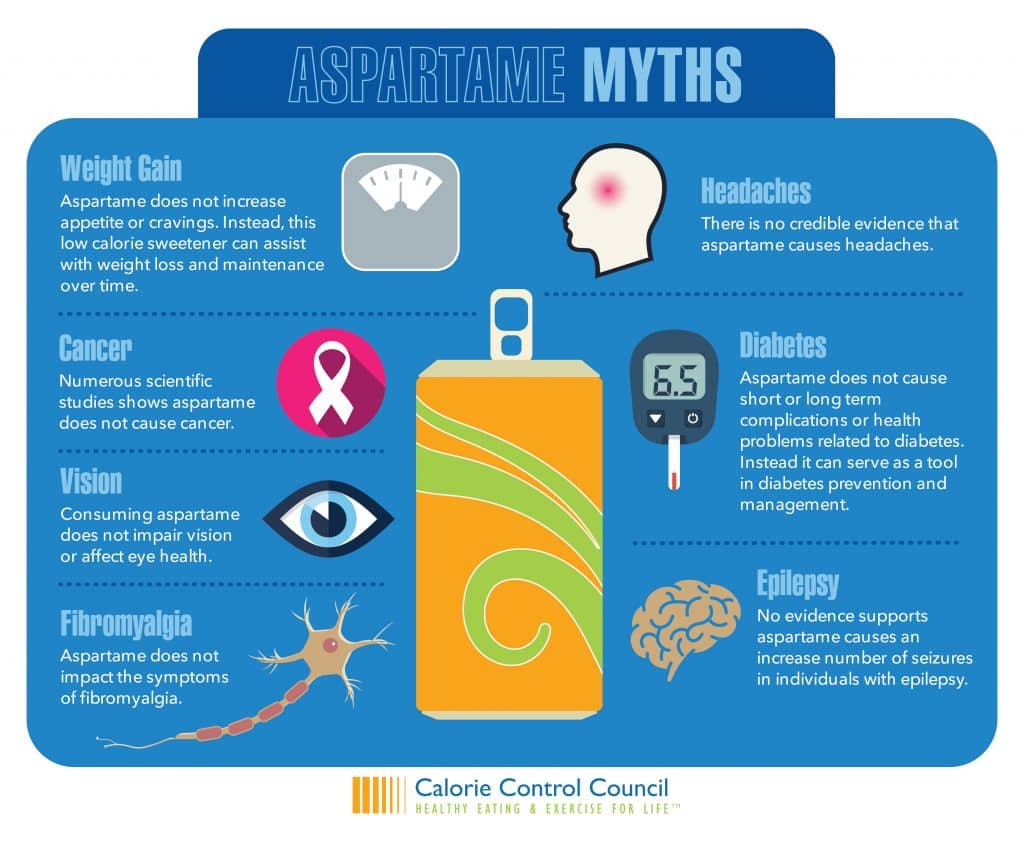
Aspartame Myths
Aspartame is one of the most thoroughly studied food ingredients ever, with more than 200 scientific studies supporting its safety. In addition to the Food and Drug Administration (FDA), the Joint Expert Committee on Food Additives (JECFA) of the World Health Organization and Food and Agriculture Organization, the Scientific Committee on Food of the European Union (SCF), and regulatory agencies in more than 100 countries have reviewed aspartame and found it to be safe for use.
theClaims
- WEIGHT GAIN
MYTH: Even though aspartame is a low-calorie sweetener, claims abound that it stimulates appetite, hunger and sweet cravings leading to increased food intake and weight gain. These assertions are often based on personal testimonials and misinterpretation of observational studies that don’t show cause and effect between weight gain and aspartame.
For example, simply observing overweight individuals consuming diet soda does not explain why they are consuming them and if intake causes any changes. Being overweight may have led them to try diet drinks to save calories. Different types of studies have been conducted to determine the effects of consuming low-calorie sweeteners.
FACT: In numerous studies that compare diets with and without low-calorie sweeteners, results consistently show that low-calorie sweeteners decrease calorie intake and promote weight loss. A recent comprehensive analysis of low-calorie sweeteners and weight concluded that substituting low-calorie sweetened options for their regular-calorie versions resulted in a modest weight loss, and that they may be a useful dietary tool to improve compliance with weight loss or weight maintenance plans. Another review of studies also found that using foods and drinks sweetened with aspartame instead of sucrose (table sugar) is an effective way to lose and maintain weight without reducing the palatability of the diet. And the Position Paper of The Academy of Nutrition and Dietetics: Use of Nutritive and Nonnutritive Sweeteners states, “Use of aspartame and aspartame-sweetened products as part of a comprehensive weight loss or maintenance program by individuals may be associated with greater weight loss and may assist individuals with weight maintenance over time.”
BOTTOM LINE: The use of aspartame and aspartame-sweetened products assists with weight loss and maintenance over time.
- HEADACHES
MYTH: While scientific literature does not support this claim, the popular media is filled with reports that aspartame causes headaches.
FACT: Researchers have consistently found no difference in headache incidence among those consuming aspartame vs. those who do not. These include studies published in the New England Journal of Medicine, The Journal of Clinical Pharmacology, and The Journal of Allergy and Clinical Immunology.
BOTTOM LINE: There is no evidence pointing to aspartame causing headaches.
- CANCER
MYTH: A limited number of animal studies have linked aspartame to blood (hematopoietic) and brain cancers, causing some speculation that aspartame might cause cancer in humans.
FACT: Most animal studies have found no increase in cancer risk even with high doses of aspartame.
While animal studies are often used to test for safety and explore possible mechanisms and pathways that may be relevant to people, it is important to remember that there are a number of differences in animals and people that can limit how relevant these findings are. More importantly, speculation from animal studies often leads to studies in people.
Studies in humans find do not support the myth that aspartame causes cancer including one that concluded “findings do not support the hypothesis that aspartame increases hematopoietic or brain cancer risk.” Another review of nearly 50 studies looking at low-calorie sweeteners and cancer stated that “despite some rather unscientific assumptions, there is no evidence that aspartame is carcinogenic.” The National Cancer Institute states that low-calorie sweetener and cancer studies have not provided clear evidence of an association with cancer in humans. Based on evaluations from the US Food and Drug Administration and the European Food Safety Authority, The American Cancer Society says studies done so far have not found a link between aspartame and cancer.
BOTTOM LINE: Evidence does not support the myth that aspartame causes cancer.
- DIABETES MANAGEMENT (Blood Glucose/Sugar Management)
MYTH: Individuals with diabetes have to eliminate sweet foods and beverages, including those sweetened with low-calorie sweeteners like aspartame, from their diet.
FACT: Individuals with diabetes need to control their blood glucose to reduce the risk of short-term complications and serious long-term health problems. This need is much more relevant to many than the results from a few recent studies in rats and mice that suggest low-calorie sweeteners may alter intestinal microbes so that it leads to glucose intolerance with an increased risk of Type 2 diabetes. There are well-established differences in rodents and people. Importantly, research related to the intestinal microbes is far too preliminary to draw any conclusions or to change recommendations on sweetener use in people.
A 2013 paper published in US Endocrinology concluded, “Low-calorie sweeteners can serve an important role in diabetes prevention and management. Substituting sugars with low-calorie sweeteners provides patients with type 2 diabetes considerable flexibility in their health goals and personal dietary preferences.” According to the Joslin Diabetes Center, “The safety of aspartame has been well established. The results of these scientific studies have shown that eating products sweetened with aspartame is no different from eating other foods and is not associated with adverse health effects.”
BOTTOM LINE: Low-calorie sweeteners, like aspartame, can serve an important role in diabetes prevention and management, and do not cause short- or long-term complications or health problems.
- VISION
MYTH: It has been suggested that aspartame consumption could impair vision because one of its components is methanol, which in large amounts can affect vision.
FACT: The small amount of methanol from aspartame is much lower than methanol derived from other foods and beverages. In fact, a glass of tomato juice provides about six times as much methanol as the same amount of an aspartame-sweetened beverage. When aspartame is digested in the gut, the body easily metabolizes the methanol the same way it does from other foods and beverages. The human body also makes and excretes some methanol through normal processes. In a 2014 scientific opinion, the European Food Safety Authority concluded that dietary methanol including that from aspartame does not cause adverse effects as it makes up only a very small portion compared to the natural production by the body. In addition, numerous scientific studies have shown that the methanol from aspartame does not accumulate in the body and thus cannot reach harmful levels.
BOTTOM LINE: The amount of methanol consumed from aspartame is much lower than levels found in other foods and beverages, thus the consumption of aspartame does not impair vision.
- EPILEPSY
MYTH: While research does not support this claim, some think aspartame can cause seizures in people with epilepsy.
FACT: In one study with epileptic children there was no difference in the occurrence of seizures when they consumed a diet containing aspartame versus one that did not. In another study, adults and children given capsules with aspartame or a placebo experienced no seizures or other adverse effects from consuming aspartame.
BOTTOM LINE: No evidence supports aspartame causes an increase number of seizures in individuals with epilepsy.
- FIBROMYALGIA
MYTH: There are a few reports of individuals who say their symptoms of fibromyalgia, a condition characterized by muscle and bone pain, decreased when they eliminated aspartame from their diet.
FACT: A controlled study with 72 women published in Rheumatology International found that elimination of aspartame did not improve the fibromyalgia symptoms.
BOTTOM LINE: Aspartame does not impact the symptoms of fibromyalgia.
Latest Research
Browse available scientific research articles on aspartame.


Aspartame Lifestyle
Learning to live a healthier lifestyle is easy when you change one small thing at a time. Find recipes and tips to start the change today!
Learn more
Frequently Asked Questions
We’ve got the answers to your frequently asked questions about the popular low-calorie sweetener, aspartame.
Learn more
Aspartame Products
Substituting aspartame for sugar or other calorie-containing sweeteners allows people to indulge sweet cravings while consuming fewer calories.
Learn more