| |
The BENEFITS of Aspartame and Low-Calorie
Sweeteners
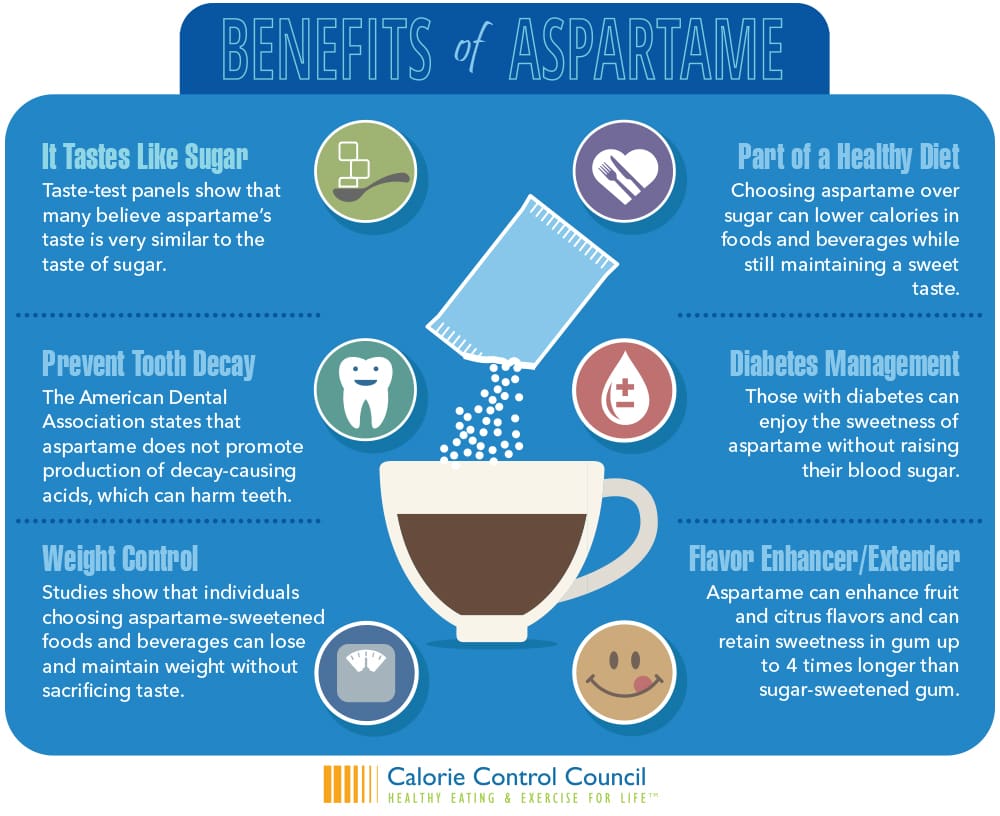
Low-calorie sweeteners provide consumers with many benefits, both
psychological and physiological. Health professionals and consumers
believe low-calorie sweeteners are effective for the following purposes:
weight maintenance, weight reduction, management of diabetes, reduction
of dental caries, and reduction in the risks associated with obesity.
For more than 163 million adult Americans, low-calorie sweeteners
offer a means to enjoy good-tasting foods and beverages without
the calories. Research shows that consumers of low-calorie, sugar-free
foods and beverages have incorporated these products into an overall
healthy lifestyle. Staying in better overall health is rated as
the number one reason for using low-calorie products. For many low-calorie
product consumers, staying in better overall health includes achieving
and maintaining a proper weight.
People use low-calorie foods and beverages for many reasons other
than dieting. Seventy-three percent of low-calorie product consumers
are not on a diet. For these people, "calorie consciousness"
does not mean a commitment to weight control or weight reduction.
Instead, these "non-dieters" use low-calorie products
as part of a healthy lifestyle.
Allegations have been made that the benefits of low-calorie sweeteners
are not well documented. In fact, scientific evidence supports the
benefits of low-calorie sweeteners, particularly regarding weight
control. The role of low-calorie sweeteners in weight control can
be summarized as follows:
- For many, low-calorie sweeteners offer a means to control caloric
intake, allowing the substitution of low-calorie foods and beverages
for their higher calorie counterparts. The increased availability
of good-tasting, low-calorie products has made "calorie juggling"
a popular method for maintaining weight.
- Health professionals agree that the key to losing weight is
to burn more calories than are consumed, either by increasing
physical activity or consuming fewer calories -- or preferably,
both. As part of a sensible weight-control program, low-calorie
sweeteners can help consumers reduce caloric intake and therefore
help them lose weight.
- Low-calorie sweeteners provide weight-conscious individuals
with a greater variety of food and beverage choices in their diets.
Also, low-calorie foods and beverages are easily incorporated
into a lifelong, sensible weight-control program.
- "Successful" weight reduction -- losing weight and
keeping it off -- involves many factors, such as eating habits
(including a balanced diet, eaten in moderation), exercise and
long-term commitment. Allegations that one component of a person's
diet, in this case low-calorie sweeteners, is responsible for
weight-loss failure cannot be supported, especially when other
dietary and lifestyle factors are not controlled. In fact, the
majority of those who use low-calorie sweeteners to lose or maintain
weight do not rely solely on these products.
- Though low-calorie foods and beverages can play a key role in
successful weight loss, they cannot be held responsible for weight-loss
failure. The ultimate success of any weight-loss program depends
on the individual -- not any particular product.
- Human and animal evidence exists which supports the effectiveness
of low-calorie sweeteners in controlling caloric intake.
- Opinion research has revealed that the vast majority of U.S.
health professionals judge a low-calorie sweetener to be of benefit
for weight control.
- Claims by some that low-calorie sweeteners cause people to gain
weight are essentially speculation and are not well founded scientifically.
In fact, scientific evidence points to the opposite conclusion.
Speculation that low-calorie sweeteners make people eat more has
been generally contradicted by laboratory and clinical studies.
Additionally, extensive clinical research shows that low-calorie
sweetener use does not result in increased caloric intake or lead
to weight gain.
- In any discussion of low-calorie sweeteners and their role in
weight control, it is important to note that these sweeteners
are not drugs designed for the purpose of weight reduction. There
are no miraculous weight loss claims made in the marketing of
these products, as they are tools that can be used as part of
an overall healthy diet.
|